Ride the Loop, Run the Streets: A Yamanote Line Point-to-Point Strategy
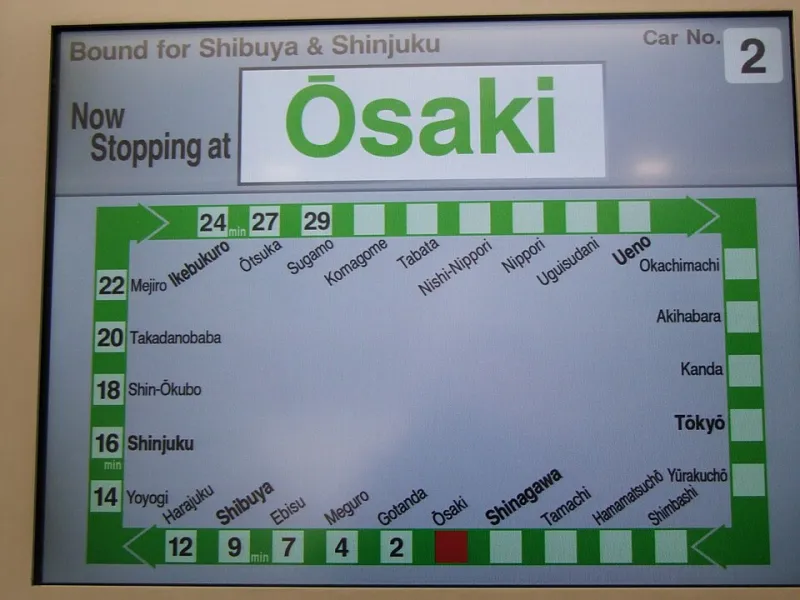
Photo: Pencil2104, CC BY-SA 4.0, via Wikimedia Commons
Most visitors see the Yamanote Line as a way to get from sightseeing stop to sightseeing stop. Runners should see it as a planning grid. The green loop ties together Tokyo's major stations, and that makes point-to-point city runs surprisingly simple: pick a start, pick a finish, run the streets between them, and take the train back. No backtracking, no complicated return route, no staring at a map at every corner.
Why the Yamanote Works as a Run Map
The Yamanote Line circles central Tokyo through stations like Tokyo, Ueno, Shinjuku, Shibuya, and Shinagawa. Trains run frequently, station names are posted in English, and the line is easy to use with an IC card. For a runner, the value is not the train itself. It is the built-in safety net. If you bonk, the weather turns, or you simply finish early, there is usually a Yamanote station within a reasonable distance.
The catch is that the Yamanote is a circle, not a trail. You are running on city streets, beside busy roads, through shopping districts, and past station construction. This is urban miles, not a nature escape. Plan for traffic lights, pedestrians, and the occasional hill. The reward is a tour of Tokyo's neighborhoods at street level, with a train ticket home.
The Basic Plan: A to B, Then Train Back
Choose two stations on the same side of the loop. Run from A to B along surface streets. At B, enter the station, buy a ticket or tap your IC card, and ride back to A. That is the whole system.
If you have a bag, use a coin locker at A before you start. You will return to A by train, so you can retrieve it without carrying anything on the run. If you are traveling with a US phone that has Suica in Apple Wallet, you do not need a paper ticket at all. Tap in at B, tap out at A, and you are done.
Keep the segment realistic. A 4 to 7 kilometer point-to-point run is plenty for a sightseeing day. If you want a full 10K, connect two segments or choose a longer arc of the loop. Do not overplan the route. Use station names, major avenues, and offline maps as backup, but let the streets do the work.
Segment 1: Shinjuku to Shibuya via Yoyogi and Harajuku
This is the classic city-run segment, roughly 4 to 5 kilometers depending on your line. Start at Shinjuku Station's south side and make your way toward Yoyogi. From there, head through the Yoyogi Park area toward Harajuku, then continue to Shibuya.
Early morning is the time to do this. By late morning on weekends, Harajuku and Shibuya are packed with shoppers, and the sidewalks become a slalom course. Start around 6:30 or 7:00, run before the stores open, and finish at Shibuya Station. From Shibuya, the Yamanote Line takes you back to Shinjuku in a few stops.
This segment is not a pure park run. You will cross busy roads and pass station crowds. But it gives you a real feel for Tokyo's west side: quiet residential blocks, the edge of Yoyogi Park, the Harajuku backstreets, and the sudden density of Shibuya.
Segment 2: Shibuya to Shinagawa via Ebisu, Meguro, Gotanda, and Osaki
For a longer, more urban run, take the south side of the loop. Shibuya to Shinagawa via Ebisu, Meguro, Gotanda, and Osaki is roughly 7 kilometers. It is less scenic than the Shinjuku-to-Shibuya segment, but it is a solid city miles route with frequent stations and plenty of convenience stores.
Expect some hills and a lot of road crossings. Meguro and Gotanda have quieter side streets if you drift off the main roads. Osaki is a good mental checkpoint: once you pass it, Shinagawa is close. Finish at Shinagawa Station, where the Yamanote Line and many other lines converge. Ride back to Shibuya or continue to your hotel.
This segment is best on a weekday morning before 7:30 or on a Sunday before 9:00. Avoid weekday rush hour, when station exits and sidewalks are full of commuters. If you run in summer, start early and carry water. The south side has fewer park drinking fountains than you might expect.
Segment 3: Ueno to Tokyo via Akihabara and Kanda
If you want a shorter, denser city run, try Ueno to Tokyo via Akihabara and Kanda. It is roughly 3 to 4 kilometers and gives you a different slice of Tokyo: market streets, electronics shops, old commercial blocks, and the approach to Tokyo Station.
This one is best very early on a weekend, before Akihabara's shops open. The sidewalks are narrow in places, so keep a steady pace and do not weave through crowds. Finish at Tokyo Station, then take the Yamanote Line back to Ueno. It is a good rainy-day option too, since you can bail at Akihabara or Kanda if the weather turns.
Reading Exits at the Finish
Japanese station exits are numbered, and those numbers are your friend. At bigger stations, look for signs that say Central Exit, South Exit, Hachiko Exit, or Takanawa Exit, along with exit numbers. Before you start, screenshot the exit name you need at the finish station. When you arrive, follow the yellow and black signs rather than guessing.
At Shibuya, the Hachiko Exit is the famous meeting point, but it is also crowded. At Shinjuku, the station is enormous, so pick a specific exit such as East Exit or South Exit and stick to it. At Shinagawa, the Takanawa Exit is useful for the Yamanote platforms. At Tokyo Station, the Marunouchi side is the classic red-brick view, but the Yaesu side is often easier for a quick train connection.
Give yourself 5 to 10 minutes to walk from street level to the Yamanote platforms. Big stations are not quick. Do not enter the ticket gates until you have your ticket or IC card ready.
Fare Machines and IC Cards in Plain English
If you use Suica or Pasmo, the process is simple: tap in at the finish station, ride to your start station, and tap out. The fare is calculated automatically. If you use a paper ticket, find the fare map above the machines. Locate your destination station, note the fare, insert coins or bills, and take your ticket. Feed the ticket into the gate, and pick it up on the other side.
If you underpay, use the fare adjustment machine near the exit gates. If you overpay, you can usually get a refund at the station office, but it is easier to buy the right ticket the first time. US travelers with an iPhone can add Suica to Apple Wallet before the trip and reload it with a compatible credit card. Keep your phone charged, because a dead phone means no tap-and-go.
Timing, Water, and Crowds
Run early. Weekday rush hours from 7:30 to 9:30 a.m. and 5:00 to 7:30 p.m. are not fun on these segments. Weekend midday is also busy around Shibuya, Harajuku, and Shinjuku. Early morning gives you cleaner air, quieter sidewalks, and better photos.
Water is easy to find at convenience stores and vending machines, but carry at least 500 milliliters. Public trash cans are rare, so plan to carry wrappers until you find a store or station bin. Bathrooms are available at stations, parks, and convenience stores. Carry a small towel and coins for emergencies.
Local Etiquette for City Miles
Keep left on sidewalks, yield to pedestrians, and cross at signals. Do not run through station crowds or shopping arcades at speed. If you need to check your phone, step to the side. A quiet sumimasen goes a long way when you need to pass. And remember that the Yamanote Line is a commuter railway, not a running track. Save your fast intervals for the street and keep the station calm.
The Yamanote Line will not give you a mountain sunrise or a forest trail. What it gives you is something more practical: a city-sized loop of stations, a reliable return trip, and the freedom to run one-way through Tokyo without worrying about how to get back. Pick two stations, pack light, and let the green line handle the logistics.