Station Signs Without the Scramble: A US Traveler's Guide to Japanese Exits and Gates
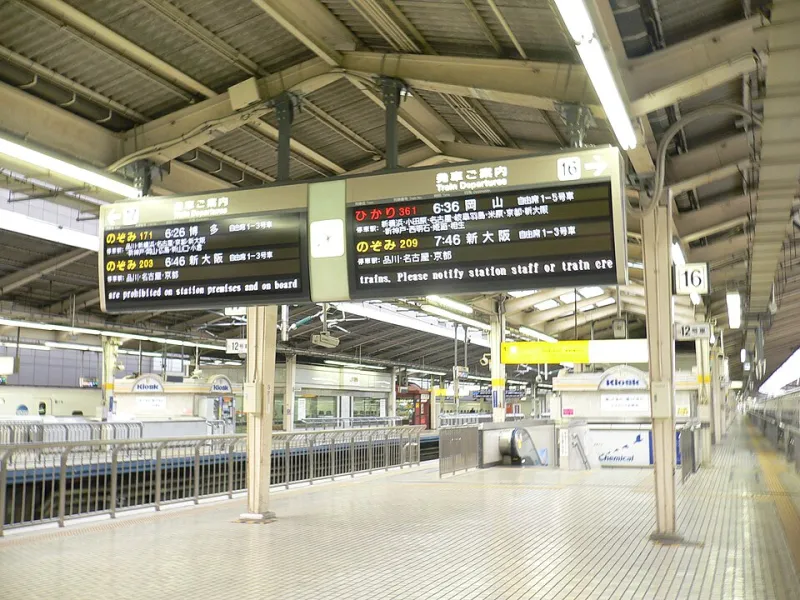
Photo: User:Araisyohei, CC BY-SA 3.0, via Wikimedia Commons
Japanese train stations can feel like a test you didn't study for. You come up from a platform, see a wall of signs, and suddenly everyone else is walking with purpose while you're rotating like a weather vane. Here's the good news: Japanese stations are usually logical. They just ask you to read them in a different order than you're used to.
Exits are addresses, not suggestions
In the US, 'use the south exit' often means 'walk out and figure it out.' In Japan, an exit is a precise pin on the map. Exit numbers—A4, B1, 3, 7—tell you exactly which stairway or passage to take. Directional names do the same thing: minami-guchi is south exit, kita-guchi is north exit, higashi-guchi is east, nishi-guchi is west, and chuo-guchi is central. Once you understand that, the station stops being a maze and starts being a labeled building.
The trick is to treat your exit as the final step of the trip. Before you go into the station, note the exit number or name your hotel, restaurant, or landmark is closest to. If the map says Exit A4, don't settle for Exit A3 and hope for the best. They can be a block apart.
Read the station in four layers
Big hubs like Tokyo, Shinjuku, and Kyoto stack multiple systems in one building: JR, subway lines, private railways, bus terminals, and underground shopping. Don't try to read the whole wall at once. Read it in layers.
First, identify the operator and line. Is this JR, Tokyo Metro, Toei, Keio, Odakyu, or something else? Second, find the line color and code. Tokyo Metro lines use letters and numbers—M for Marunouchi, G for Ginza, and so on—while JR lines often use color and destination. Third, find the platform number and direction. Fourth, find your exit number or name and the street-level landmark.
That order matters. If you look for 'Shinjuku' first, you'll drown. If you look for 'JR Yamanote Line, platform 15, south exit,' you have a path.
Colors and letters are your friends
Japanese transit maps love color, and for once that's helpful. A green line is not decoration; it's a shortcut for your brain. Station codes like M-15 or G-09 are even better because they survive language changes. You can match the code on your phone to the code on the sign without reading a single kanji character.
The catch is that colors repeat across operators. Two different companies can both use red. So use color as a first filter, then confirm the line name and platform. Also, pay attention to 'for' signs. A platform sign that says 'for Shibuya' or 'for Ikebukuro' is telling you the direction, not just the destination.
The minami-guchi confusion, explained
'Guchi' means exit, so minami-guchi is the south exit. That part is simple. The confusion starts at big stations where the south side is split into multiple exits, or where a department store, bus terminal, or underground concourse has its own south entrance. You'll see signs for 'South Exit,' 'New South Exit,' 'South Exit (JR),' and 'South Exit (Metro)'—and they are not always the same doorway.
Don't assume south is the main side, either. At Tokyo Station, the Marunouchi side is west and the Yaesu side is east; both are main. At Kyoto Station, the Karasuma side is north and the Hachijo side is south, and the Shinkansen area connects strongly to Hachijo. At Shinjuku, the East Exit, West Exit, and South Exit serve completely different neighborhoods. 'South' is a direction, not a guarantee that your hotel is nearby.
A repeatable method for Tokyo, Shinjuku, and Kyoto
At Tokyo Station, decide before you enter whether you want the Marunouchi side or the Yaesu side. Marunouchi is the historic red-brick side facing the Imperial Palace; Yaesu is the bus and business side. For the palace loop, aim for the Marunouchi Central Exit. For a bus or a quick transfer, Yaesu may be better. Don't just follow the crowd—crowds are going to platforms, not your hotel.
At Shinjuku, pick your exit letter or number before you surface. The East Exit is Kabukicho and nightlife, the West Exit is skyscrapers and the Metropolitan Government Building, and the South Exit is the bus terminal and New South area. Shinjuku's underground passages are useful but easy to overtrust. If you're not sure, go up to street level, get your bearings, and walk the last block above ground.
At Kyoto Station, the north side (Karasuma) is your downtown and city-bus side, while the south side (Hachijo) is the Shinkansen and south-hotel side. If you're meeting someone, name the exit, not just the station. 'Kyoto Station' is the size of a small airport.
When you take the wrong exit
It happens. You surface, see a taxi rank instead of your ramen shop, and feel the urge to sprint. Don't. Walk back into the station, find a station map, and look for your exit number. JR stations usually have a Midori no Madoguchi ticket office or information counter; subway stations have staffed gates or information boards. Google Maps often labels exits, but it's only as good as your signal.
A simple phrase helps: 'Sumimasen, [exit number] wa doko desu ka?' means 'Excuse me, where is Exit [number]?' You don't need perfect pronunciation. Pointing at the number on your phone works too.
Sign words worth knowing
Deguchi and guchi mean exit. Noriba means platform. Kaisatsu is ticket gate. Chuo is central. Kita, minami, higashi, and nishi are north, south, east, and west. Mae means in front of, which is why you'll see 'station-mae' on bus stops and addresses. Learn those few words and the signs start to read like a map instead of a puzzle.
The real confidence boost is simple: Japanese stations tell you more than most US stations do. They give you numbers, colors, letters, and directions. You don't need to read everything. You just need to pick the layer that moves you forward.